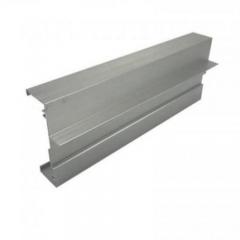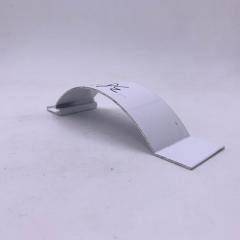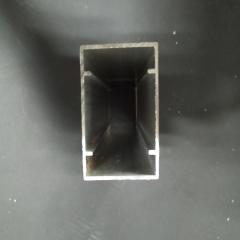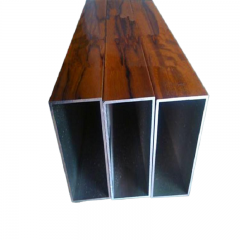
Before you compare suppliers or scan aluminum tube stock pages, it helps to answer one basic question clearly: what is this material, and why is it used so often? For first-time buyers, that definition prevents costly mix-ups. For technical readers, it sets up the more important decisions around shape, dimensions, and specification language.
Aluminum tube is a hollow aluminum product, commonly made through extrusion, drawing, or welding, and supplied in shapes such as round, square, or rectangular for lightweight, corrosion-resistant assemblies.
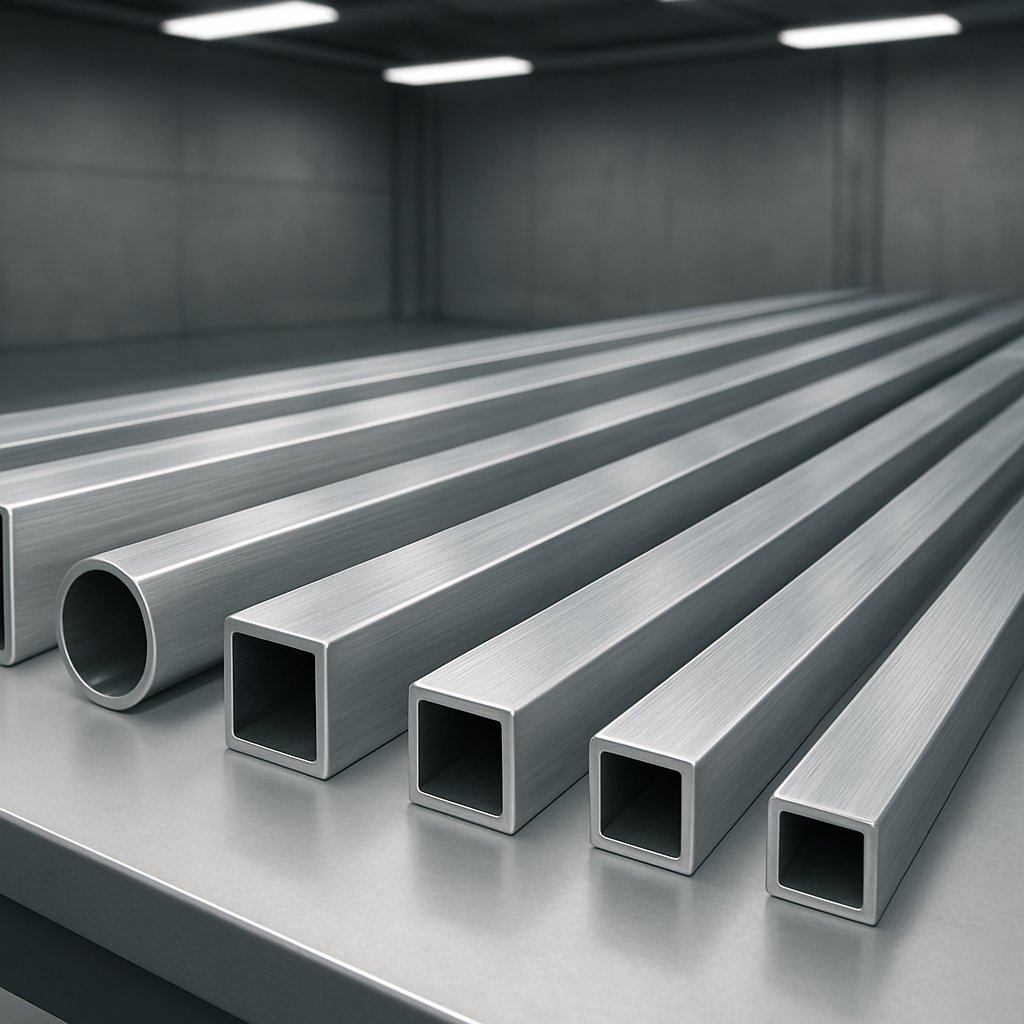
In everyday terms, it is aluminum formed into a hollow section instead of a flat sheet, solid bar, or thick plate. A TACO Marine overview notes that tubes can be produced in multiple shapes, including round, square, and rectangular forms, which is one reason aluminum tubes appear across so many industries. You might see a round aluminum tube in rails, frames, or routed systems, while a square aluminum tube may be chosen when a project calls for a different profile.
The appeal is practical. Aluminum is widely valued for low weight, corrosion resistance, and a strong strength-to-weight balance. It also accepts paint and decorative finishes well. Continental Steel describes aluminum tubing as durable while being about one-third the weight of steel, which helps explain its popularity in transportation, framing, and general fabrication. The same combination also makes it relevant for marine exposure, recreation products, machine parts, and finish-sensitive work.
Among common metal forms, this product sits in a useful middle ground. It is lighter than a comparable solid section because of its hollow interior, yet it still supports many structural and fabrication tasks. It can serve in frames, racks, fuel and hydraulic line-related systems, marine hardware, and other fabricated assemblies where reduced weight matters. That said, not every hollow product is specified the same way. A round aluminum tube may look similar to pipe at a glance, but the naming, measurement, and quoting logic can differ enough to change the final purchase decision.
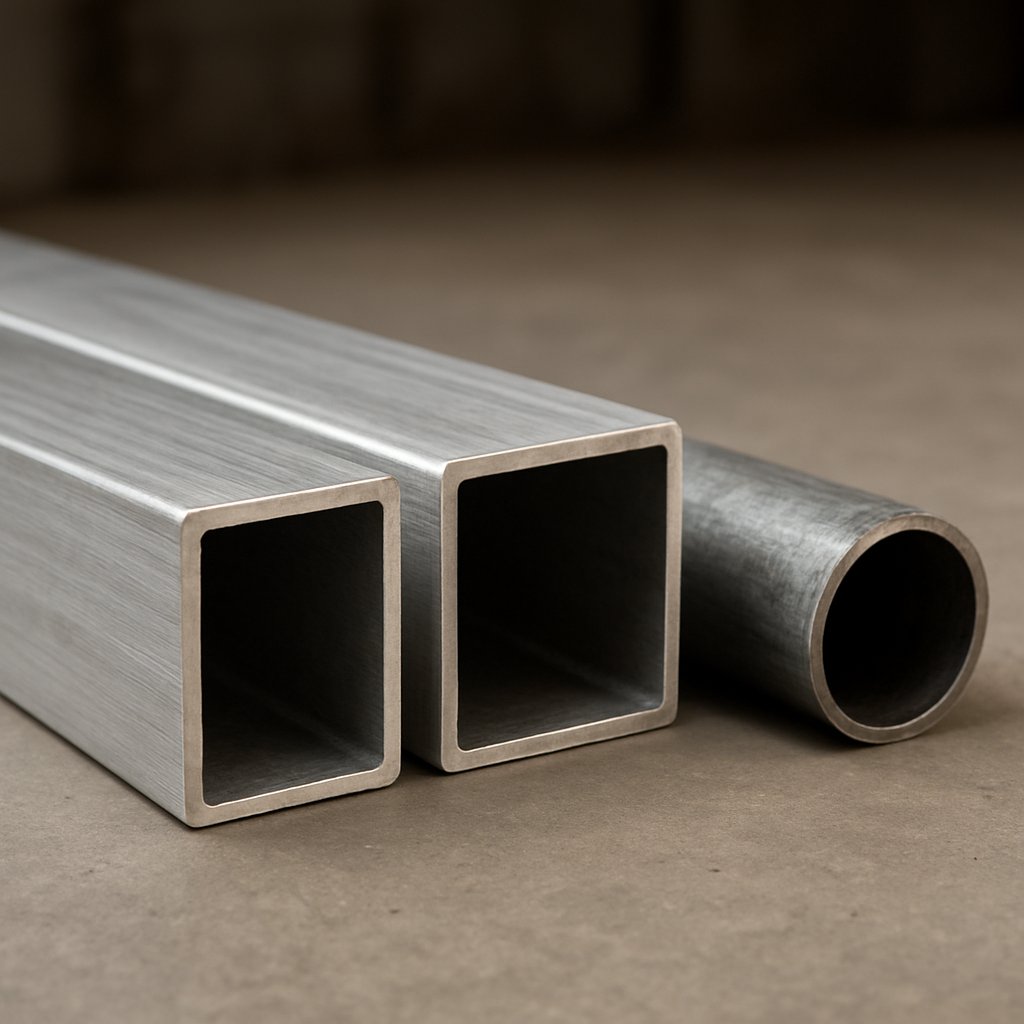
That look-alike problem causes more quoting mistakes than many buyers expect. Two hollow sections can sit side by side, appear nearly identical, and still be specified in completely different ways. If the language on the drawing is off by just a little, the part you receive may be wrong for the job.
For tubing, the sizing logic is usually direct. Merit Brass notes that tubing is measured by exact outside diameter, or OD, plus wall thickness. ID means inside diameter, and it changes as wall thickness changes. A 1.25 in tube is exactly 1.25 in at the OD.
Pipe uses a different naming system. It is round and is commonly called out by nominal pipe size, or NPS, plus schedule. Schedule identifies wall thickness, but NPS is not the same thing as actual OD. Merit Brass shows that an NPS 2 pipe has a 2.375 in OD, which is exactly why tube and pipe should never be treated as interchangeable just because both are hollow. When buyers discuss aluminum tube dimensions, they usually mean actual outside size and wall, not nominal pipe naming.
| Form | How it is specified | Typical use intent | Finish and tolerance expectation | Fabrication and quote impact |
|---|---|---|---|---|
| Tube | Exact OD and wall thickness, with ID derived or specified as needed | Mechanical parts, frames, supports, and general fabrication | Exact exterior size matters; tolerance needs should be stated clearly | Better for connector fit, machining, and assemblies tied to real dimensions |
| Pipe | NPS plus schedule | Fluid or gas service with fittings, flanges, and valves | Wall is tied to schedule terminology rather than exact tube-style sizing | Can be misquoted if a buyer really needs exact outside fit or non-round shapes |
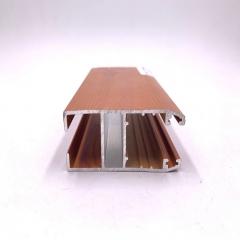
| Structural extruded tube | Tube dimensions with an extrusion-based form | General structural and fabrication work | Good general finish, but seam-related appearance can matter in some applications | Usually versatile and economical for many profiles |
| Seamless extruded tube | Tube dimensions with no extrusion weld seams | Hydraulic pressure, severe forming, and uniform strength needs | More uniform cosmetic appearance after anodizing | Chosen when seam-free construction affects performance or appearance |
| Drawn seamless tube | Final exact dimensions after drawing through dies | Precision machining and high-pressure service | Tighter tolerances and smoother finish | Often quoted higher because the process is more demanding |
An extruded aluminum tube starts with a heated billet pushed through a die. That route is widely used because it can produce many shapes, including complex hollows and varied wall sections. A seamless version also begins as extrusion, but the billet is pierced with a mandrel so the tube forms without extrusion weld seams. Some seamless products are then drawn through additional dies to reduce diameter and wall thickness. That drawing step can improve surface smoothness and tighten tolerances.
Profile Precision Extrusions describes structural, or porthole, tube as an extruded form created when billet material separates and fuses back together inside the die, leaving weld seams. That does not make it unsuitable. It often works well for general fabrication. Still, a drawn seamless part may be the better call when the application depends on closer tolerance control, smoother finish, severe forming, or pressure-related performance.
In other words, an aluminum extrusion tube and a drawn seamless option may look similar at a glance, yet quote very differently. Start by identifying the correct form and specification system. Only then does the profile choice itself become useful, because round, square, rectangular, and oval shapes each solve a different kind of design problem.
Specification mistakes often start with dimensions, but buying mistakes often start with shape. Two hollow sections can share similar size and wall thickness, yet behave very differently once they are clamped, bent, mounted, or finished. That is why profile choice should follow the job itself, not the first in-stock option that looks close enough.
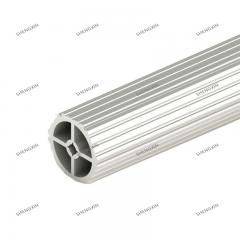
An aluminum round tube is usually the safest starting point when loads may arrive from changing directions or when the part needs a clean, continuous outline. Because it has no corners, it does not force a preferred rotational position the way a rectangular profile does. It also tends to work well in curved assemblies, rails, guards, and routed systems. Market examples on Metal Supermarkets align with that pattern, showing round tubing used for framework and commercial or cosmetic applications. In practice, aluminum round tubes are also popular where rolling or bending is part of the fabrication plan.
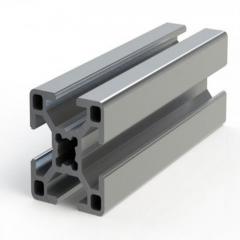
An aluminum square tube earns its popularity with fabricators for a simple reason: flat sides make life easier. Clamps sit flat. Brackets land flush. Connectors and plates are easier to align. That is why aluminum square tubes appear so often in frames, supports, racks, guards, and general shop fabrication. In everyday sourcing language, square tube aluminum is often the default for structures that need straightforward layout and fast assembly.
An aluminum rectangular tube adds another advantage. Its longer face lets the section be oriented to favor one bending direction over the other, which can be useful in trailers, rails, lightweight framework, and bracket-heavy assemblies. It also stacks and nests better than round profiles, which helps with storage and material handling.
Shape affects more than strength. It changes the visual style of the finished part and the type of hardware needed to build it. A Chalco oval guide highlights the oval aluminum tube for architectural, furniture, marine, and transport-related applications because its elliptical form can offer directional bending resistance while presenting a softer, more streamlined look than a boxy section. That can be useful for handrails, trim, and exposed assemblies where appearance matters as much as structure.
| Shape | Behavior under load | Joining and clamping | Nesting and appearance | Common application categories |
|---|---|---|---|---|
| Round | Balanced around the section with no corner orientation; good for curved or multi-directional layouts | Often needs saddles, U-bolts, formed clamps, or welded tabs rather than simple flat plates | Does not stack as neatly, but gives a smooth, continuous look | Rails, framework, transport components, routed systems, bent assemblies |
| Square | Balanced on its main axes and resistant to rolling on the bench or in service | Very clamp-friendly; easy to bolt, sleeve, bracket, and fixture | Stacks cleanly and gives a crisp, industrial appearance | Framing, machine guards, supports, racks, general fabrication |
| Rectangular | Directional stiffness makes orientation more important; strong choice when one axis matters more | Excellent for flat mounting faces, tabs, gussets, and mechanical connections | Best nesting efficiency of the common stock shapes; more visual emphasis in one direction | Trailers, structural frames, architectural supports, brackets, rails |
| Oval | Directional behavior between round and rectangular forms; useful where profile depth and width must be balanced | May need custom clamps or formed connectors; fewer stock fittings than square profiles | Packages well and offers a softer, more decorative look | Handrails, furniture, architectural work, marine fittings, decorative fabrications |
Copying a profile from availability alone can leave you with awkward joints, extra fabrication time, or a finished part that looks wrong in service. Shape should answer three questions first: where the load acts, how the assembly comes together, and what the installed part should look like. Get those answers right, and the remaining choice becomes more precise: which alloy and temper will give that profile the strength, corrosion behavior, and finish quality the application actually needs.
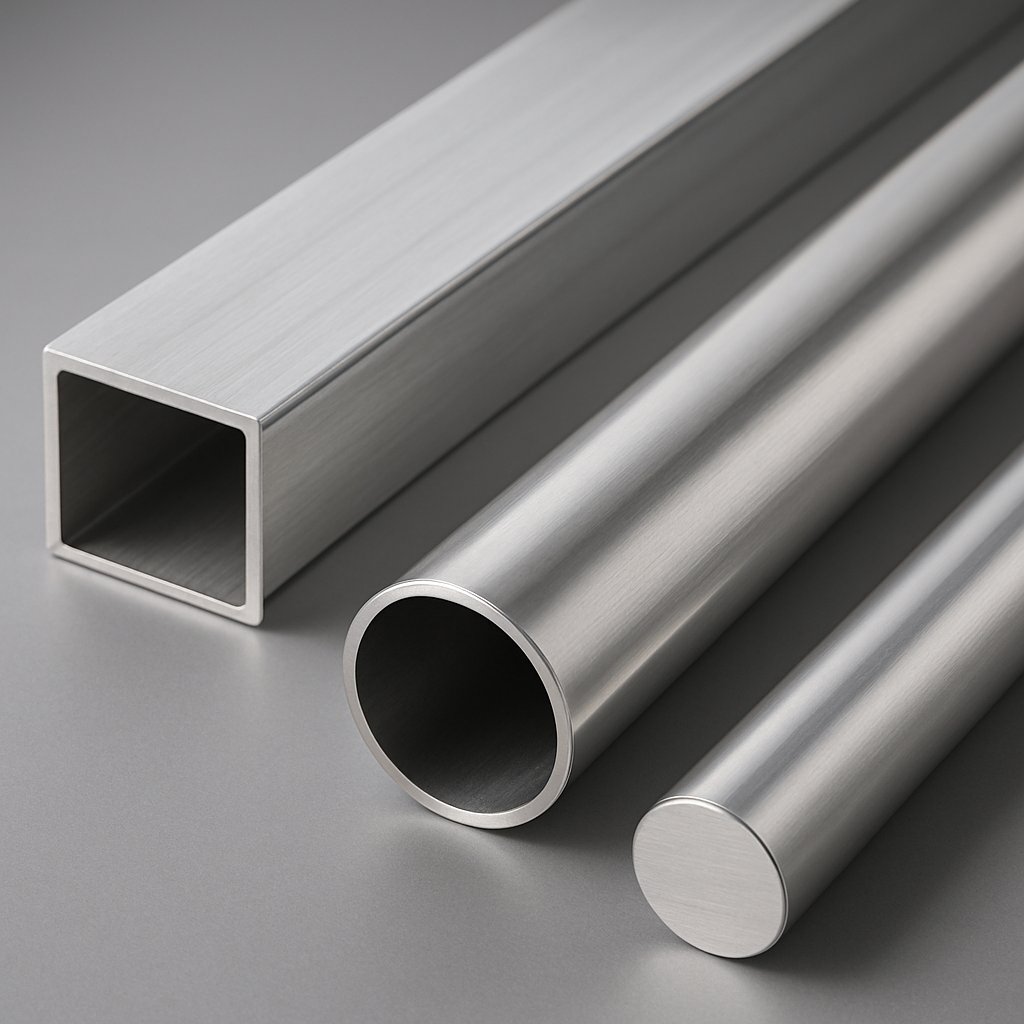
Profile choice decides the shape. Alloy decides how that shape behaves when it is welded, machined, bent, anodized, or pushed into service. That is why two tubes with the same size can perform very differently. In most supplier assortments, the frequent appearance of 6061 and 6063 is not random. Both belong to the heat-treatable 6xxx family, both are widely available in tube forms, and each solves a different kind of buying problem.
For structural work, 6061 is usually the first serious option. Data collected by Wellste and IMS puts 6061-T6 at about 310 MPa tensile strength and 276 MPa yield strength, with good machinability, weldability, and corrosion resistance. That combination makes a 6061 aluminum tube a practical choice for frames, transport parts, towers, machined components, and many fabrication-heavy jobs.
Temper matters here. A 6061 t6 aluminum tube brings higher hardness and strength, but T6 is less forgiving for tight forming than softer tempers. IMS notes that 6061-T4 is the better pick when formability matters more than maximum strength. If a project calls for a load-bearing box section, a 6061 t6 aluminum square tube often makes sense. That is also why buyers searching for aluminum square tube 6061 usually have structural framing in mind rather than decorative trim.
6063 answers a different brief. Continental Steel describes it as the architectural alloy, known for high corrosion resistance, excellent finishing characteristics, and suitability for complex extrusions. Wellste lists 6063-T6 at roughly 241 MPa tensile strength, 214 MPa yield strength, and 200 W/m-K thermal conductivity. In plain language, it is typically chosen when appearance, extrudability, and easier shaping matter more than squeezing out every bit of structural strength.
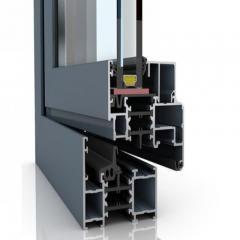
That makes 6063 a strong fit for exposed railings, trim, furniture, window and door framing, and anodized decorative tubing. The common 6061 versus 6063 confusion comes down to this: choose 6061 when strength, machining, and structural duty lead the decision; choose 6063 when cleaner surface finish, more graceful shapes, and architectural presentation matter more.
Some jobs sit outside that 6061 versus 6063 choice. IMS describes 3003 as a general-purpose alloy with good formability, corrosion resistance, and weldability, but lower strength and only fair machinability compared with 6061. It deserves attention for moderate-strength, form-first work. At the other extreme, Continental places 7075 aluminum tube in the high-strength 7xxx series used for critical aerospace parts. In other words, 7075 enters the conversation when strength is the priority and the application is far removed from everyday architectural tubing.
The quick screening table below combines the decision points buyers ask about most often.
| Alloy and temper | Strength and behavior | Machining, welding, and bending direction | Finish and anodizing direction | Typical fit |
|---|---|---|---|---|
| 6061-T6 | About 310 MPa tensile and 276 MPa yield; harder and stronger than 6063-T6 | Good machinability and weldability; better for structural fabrication than tight forming | Good surface treatment, but usually chosen for performance first | Structural tube, transport parts, machined assemblies, aluminum square tube 6061 for frames |
| 6061-T4 | Lower strength than T6, with more forming freedom | Better formability than 6061-T6; useful when shaping comes before final strength | Still suitable for finishing, but usually selected for fabrication flexibility | Fabricated parts needing bends or post-form operations |
| 6063-T6 | About 241 MPa tensile and 214 MPa yield; softer than 6061-T6 | Favored for shaping and complex extrusions; commonly chosen when appearance matters | Excellent finishing characteristics and strong anodizing appeal | Architectural, decorative, exposed railings, trim, clean-profile tubing |
| 3003-H14 or similar work-hardened tempers | Moderate strength, general-purpose performance | Good formability and weldability, but less machinable than 6061 | Useful where workability and corrosion resistance matter more than high strength | Formed, moderate-duty parts and general fabrication |
| 7075-T6 | High-strength 7xxx alloy used for critical aerospace parts | Consider when maximum strength drives the design; verify fabrication limits with the supplier | Not the usual first stop for finish-first architectural work | Specialized, strength-led applications |
A material callout like 6061 t6 aluminum tube or 6061 aluminum tube tells only part of the story. The final fit still depends on the exact OD, wall, length, and tolerance, and that is where many otherwise solid alloy choices start to drift off spec.
Alloy tells you how a section behaves. Size tells you whether it will actually fit, assemble, and machine the way you expect. Many ordering mistakes happen right here. A search term like 1.5 aluminum tube or 1 1 4 aluminum tube sounds specific, but it usually describes only a headline outside size. It does not tell you the wall thickness, inside opening, cut length, or tolerance. For buyers comparing aluminum tube sizes, those missing details are where cost and fit problems begin.
For round tubing, OD means outside diameter. ID means inside diameter. Wall thickness is the distance from the outer surface to the inner surface. The relationship is simple: ID = OD - 2 x wall thickness. A Speciality Metals guide uses that exact formula to show why a tube with a larger OD does not automatically have a large inside opening.
Square and rectangular sections are usually called out by outside width and height first, then by wall. So a 2 inch aluminum square tube normally means 2 in x 2 in outside dimensions, plus a stated wall thickness. It does not mean a 2 in clear opening. The same rule applies when reviewing aluminum square tube sizes or using an aluminum rectangular tube sizes chart as a buying shortcut.
| Term | What it means | Why it matters |
|---|---|---|
| OD | Outside diameter for round tube, or outside width and height for square and rectangular tube | Controls fit with clamps, brackets, holes, and visible overall size |
| ID | The open space inside the tube | Matters for sleeves, inserts, wiring, fluid passage, and telescoping parts |
| Wall thickness | Material thickness on each side of the hollow section | Affects weight, local crush resistance, threading, and machining allowance |
| Stock length | Mill length or cut-to-length supply condition | Changes yield, freight, saw-cut needs, and assembly planning |
| Tolerance language | Allowed variation in OD, wall, straightness, or cut length | Determines whether a part will slip fit, clamp correctly, or need rework |
| Nominal vs exact callout | Nominal is shopping shorthand, exact is the true engineering dimension | Prevents mismatches between what is ordered and what the drawing needs |
Outside size, inside size, and wall work together. OD or outside width often drives clamp fit, mounting hardware, and overall stiffness. ID controls what can pass through or fit inside. Wall thickness influences weight, dent resistance, bend behavior, and how much material is available for threads or machining.
A large diameter aluminum tube can help stiffness in some layouts, but larger is not always better. If the wall is too thin, the part may not suit the connector, thread depth, or fabrication method. A thicker wall can solve one problem while creating another by adding weight or shrinking the ID too much for an insert or routed line. Even the same outside size can behave very differently. One 1 1 4 aluminum tube may work for a light frame, while another with a heavier wall may be chosen because the joint design needs more material at the connection.
Tolerance is where many assumptions fail. Data in Onlinemetals tolerances shows that drawn 6061-T6 round tube up through 0.500 in OD is listed at +/-0.003 in on OD, while extruded round tube from 0.500 to 0.999 in OD is listed at +/-0.020 in. That gap matters when the part must mate with a bearing, plug, sleeve, or precision clamp. Extruded square and rectangular products also have their own height, width, wall, and straightness tolerances rather than one universal standard.
Length deserves the same attention. Zetwerk's size guide notes that standard stock lengths are common, but custom cut lengths are also widely used. If your job depends on tight finished length, low bow, or consistent cut ends, say so in the RFQ instead of assuming all stock is supplied the same way.
That final check matters because a perfect size on paper can still become difficult at the bender, weld table, or finishing line.
A clean drawing does not guarantee a clean part. In the shop, the same section can bend smoothly or collapse, weld neatly or distort, anodize evenly or show every mark. The difference usually comes down to alloy, temper, wall thickness, bend radius, and tooling.
During aluminum tube bending, the bend zone often stops being perfectly round and becomes slightly flattened. Tube Form Solutions describes that shape change as ovality. The risk rises when the bend radius is tight, the wall is thin, or the tooling does not support the wall well enough. That is why a part that looked fine on a stock list can become a problem at the first bend.
For tighter radii or applications with low ovality requirements, a mandrel-supported setup can help. Tube Form Solutions notes that a mandrel supports the tube wall through the bend and helps reduce flattening, wrinkles, kinks, and springback. In practical terms, complaints about flattening 6061 aluminum tube or searches for flattening ovalize aluminum tube usually point to a mismatch between temper, wall, bend radius, and the aluminum tube bender setup, not just a bad piece of material.
Do not choose alloy by availability alone. A stocked tube that bends badly or finishes poorly can cost more after rework than a better-matched grade.
Mill Steel notes that both 6061 and 6063 offer excellent weldability, but 6061 can see strength reductions in the heat-affected zone. At the same time, Wellste frames 6061 as the stronger, more machining-friendly option, while 6063 is easier to shape. That makes 6061 a frequent choice for drilled, milled, and tapped parts, while 6063 often fits formed or appearance-driven sections better.
If the design calls for a threaded aluminum tube, ask a simple question early: does the wall leave enough material for the planned thread and service load, or would an insert, boss, or fitting be safer?
Finish quality starts before finishing begins. Wellste and Mill Steel both point to 6063 as a strong choice for smooth extrusions, visible surfaces, and anodized architectural work. 6061 can also be anodized and finished successfully, but it is more often selected for strength, hardness, and machinability first. If the part will stay visible, weld cleanup, tool marks, and bend witness lines deserve the same attention as the alloy callout.
Fabrication is where material theory meets real service conditions. The shapes and alloys that behave well in a trailer frame, railing, architectural trim, or heat-related assembly are not automatically the same, which is exactly why application mapping deserves its own closer look.
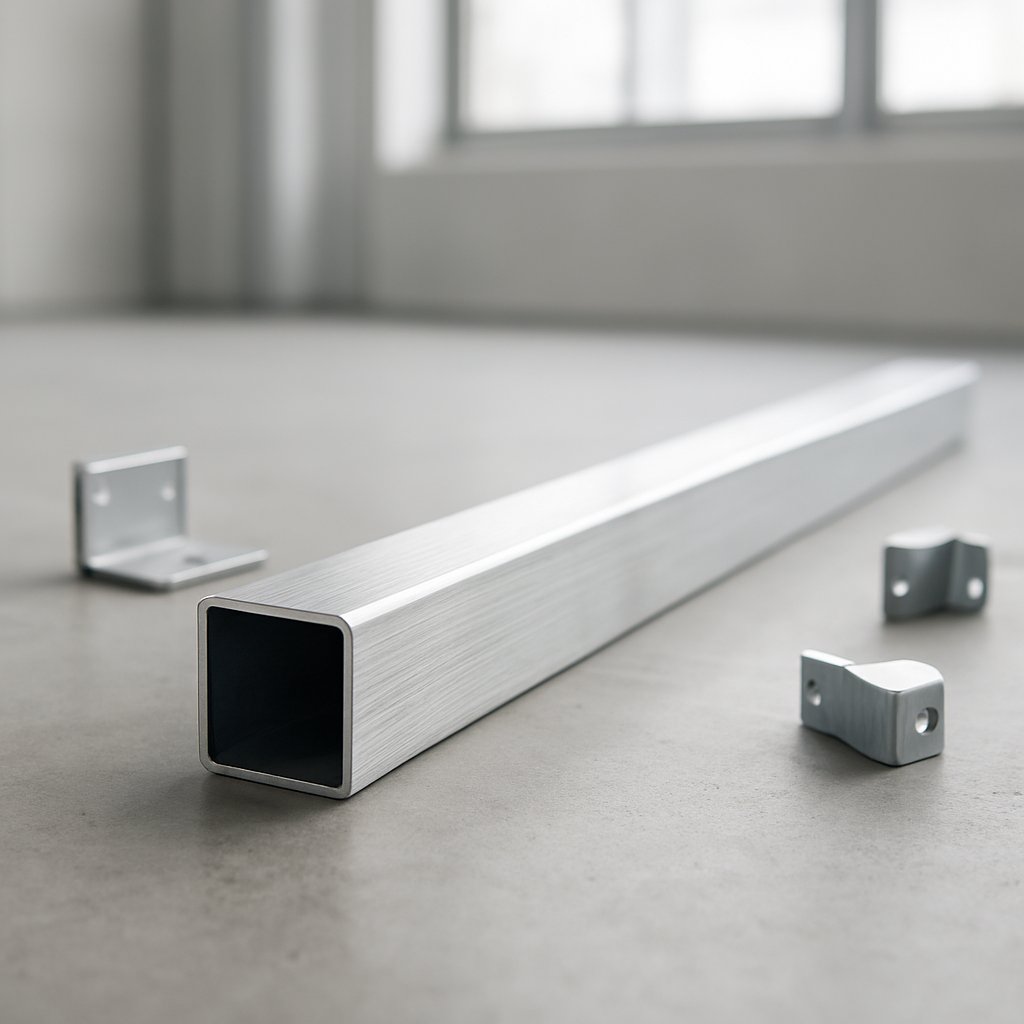
Service conditions sort out good ideas fast. A hollow section that works beautifully in a frame can be a poor fit for a railing, and a clean-looking architectural profile may not belong in a vibration-heavy assembly. Real-world selection usually comes down to four questions at once: shape, alloy direction, joining method, and exposure.
For trailers, equipment frames, guards, and general structural layouts, flat-sided profiles are often the easiest to build around. Square and rectangular sections simplify fixturing, bracket placement, and repeatable alignment. Round sections still make sense where the part will be bent, gripped from different angles, or left visually exposed. In transportation work especially, the section has to cooperate with the joint. A welded corner, bolted gusset, sleeve insert, or clamp-on mount each asks something different from the profile.
Outdoor and visible applications raise a different priority set. Marine components, exposed rails, architectural trim, and decorative fabrications all care about corrosion behavior, finish quality, and how the section reads once installed. Round and oval profiles often give a softer visual line for rails and exposed pieces, while square and rectangular forms help when the assembly needs flat contact against panels, decks, or enclosure faces. In many cases, the alloy choice follows the same split discussed earlier: structural work often leans strength-first, while exposed architectural work often leans finish-first.
Thermal assemblies follow their own rules. In a fin-and-tube coil, fins increase surface area on the air side, which is why these systems are widely used in HVAC, refrigeration, power, petrochemical, and some marine service. The fin and tube guide also shows that the important choices are not limited to tube size. Fin type, airflow, fouling risk, corrosion, and cleaning access all affect performance. That matters when reviewing applications of aluminum fin tube heat exchangers. Many aluminum fin tube applications heat transfer decisions depend on the whole coil design, and aluminum fin tube applications hvac refrigeration commonly include evaporator and condenser coils, heating coils, and dry coolers.
| Use category | Preferred shape or profile | Likely alloy direction | Common joining style | Key environment concerns |
|---|---|---|---|---|
| Trailers and light transportation frames | Square or rectangular for flat mounting and directional stiffness | Usually strength-led structural choices | Welded joints, gussets, bolted brackets | Vibration, dent resistance, post-fabrication finish |
| Equipment framing and guards | Square tube for easy layout, with round used for handles or curved guards | Balanced fabrication and strength | Mechanical fasteners, sleeves, welded tabs | Repeatable fit, service access, replacement ease |
| Marine rails and exposed components | Round or oval for appearance and touch surfaces | Corrosion-aware selection with finish in mind | Welded joints, formed bases, clamp-mounted hardware | Salt exposure, drainage, visible finish quality |
| Architectural trim and visible railings | Round, rectangular, or custom profiles based on sightlines | Finish-first architectural choices | Concealed fasteners, brackets, light welding | Anodizing appearance, surface marks, weathering |
| Decorative fabrications and furniture | Round or oval for softer lines, square for crisp modern geometry | Appearance and formability focused | Light welds, inserts, bonded or mechanical joints | Surface consistency, touch points, cosmetic cleanup |
| Heat-transfer assemblies | Round or flat-tube coil elements with fins, depending on design | Application-specific; aluminum fins are common, tube material may vary by fluid and corrosion risk | Expanded, embedded, extruded, welded, or brazed fin systems | Air-side fouling, pressure drop, corrosive air, cleaning access |
Application mapping turns a vague stock search into a usable specification. A buyer who can describe the environment, joint style, shape logic, and finish priority is already much closer to the right quote, and that is exactly where supplier comparisons start to get sharper.
A clear application map helps, but sourcing still trips up many buyers. Search phrases like buy aluminum tube, aluminum tube near me, or aluminum tube for sale can pull up very different sources. Some are fine for quick stock purchases. Others are built for repeat production, custom profiles, or tighter dimensional control. That is why the best aluminum tube supplier depends on the job, not just the search result.
When comparing aluminum tube suppliers, separate stock availability from manufacturing capability. A search result for home depot aluminum tube may help with a basic repair or mockup, but a production part usually needs a deeper review of alloy callouts, tolerances, finish state, and documentation.
| Source route | When to consider it | What to verify |
|---|---|---|
| Shengxin Aluminum | When you need more than off-the-shelf stock, especially custom tubing or custom extrusion profiles | 30 years of manufacturing experience, one-stop service, and press capacity up to 5500 tons are relevant strengths. Confirm alloy, temper, dimensions, finish, tolerance targets, and production quantity. |
| Stock distributor or service center | When a standard shape and standard size already match the drawing | Confirm exact alloy and temper, cert availability, stock length, saw-cut requirements, and whether the listed size is truly the one your assembly needs. |
| Retail or inventory listing | When you are checking immediate availability or rough material options | Use it as a starting point, then verify engineering details before ordering. A generic inventory page rarely replaces a full specification review. |
A complete RFQ saves time because it reduces clarification loops. The RFQ checklist from MakerStage notes that incomplete submissions often add 3-5 business days of back-and-forth, while complete packages typically receive quotes within 24 hours.
For mating parts, include four details up front: what mates, which feature owns the tolerance, what finished condition the dimension applies in, and how the interface will be inspected.
Custom support becomes important when the part looks simple on paper but not in production. Profile Precision Extrusions notes that achievable extrusion tolerances depend on overall size, the design feature, wall thickness, and the alloy and temper. Sinoextrud also points to press capacity and the profile's circumscribing circle as real size limits. Those details matter when buyers compare aluminum tube manufacturers, not just listings.
In practice, the smartest sourcing move is simple: match the supplier to the specification. Sometimes that means stock. Sometimes it means a custom partner with extrusion range, tolerance focus, and scale. Either way, stronger purchasing starts with a sharper RFQ, because the best quote is rarely the one based on the vaguest request.
The main difference is how each product is specified. Aluminum tube is typically ordered by exact outside size and wall thickness, which makes it better for frames, machined parts, clamps, sleeves, and other fit-critical uses. Aluminum pipe uses nominal pipe size and schedule language, so the named size does not directly match the actual outside diameter. If your part depends on precise outside dimensions or uses square or rectangular profiles, tube is usually the correct callout.
Neither alloy is automatically better. 6061 is usually favored for structural work, machining, and load-bearing assemblies because it offers a stronger strength-focused balance. 6063 is often selected for architectural and decorative tube because it is well known for cleaner surface appearance and attractive finishing results, especially when anodizing matters. A frame, bracket, or transport component may point toward 6061, while an exposed railing or trim profile may point toward 6063.
Start with the assembly method and the direction of the load. Round tube is often preferred for bending, rails, guards, and projects that need a smooth visual line from all angles. Square tube is popular for frames because flat faces make clamping, mounting, and connector use much easier. Rectangular tube works well when one direction matters more than the other, such as supports, rails, or bracket-heavy layouts where directional stiffness helps.
Yes, but the result depends on matching the alloy, temper, wall thickness, bend radius, and tooling. Thin walls, tight radii, and harder tempers raise the chance of shape change during bending. Better tooling support, including mandrel-assisted setups in demanding jobs, can reduce collapse and wrinkling. It is smart to confirm bend requirements early rather than choosing a stocked tube first and hoping it will form cleanly later.
A strong RFQ should list alloy, temper, shape, outside dimensions, wall thickness, cut length, quantity, finish, tolerance needs, and the service environment. If the tube mates with other parts, include which dimension is critical and whether it applies before or after coating, machining, or welding. Custom extrusion support becomes more valuable when you need non-standard profiles, tighter dimensional control, consistent wall thickness, or production-scale supply. In that type of project, a manufacturer such as Shengxin Aluminum can be relevant because it offers one-stop service for aluminum tubing and custom extrusion profiles, backed by 30 years of experience and press capacity up to 5500 tons.



 บริการออนไลน์
 0086 136 3563 2360
 sales@sxalu.com
 +86 136 3563 2360
 ไทย
ไทย English
 français
 Deutsch
 русский
 español
 português
 العربية
 Việt
Việt Українська